George Livingston M.S. in Biochemistry
Cognitive psychologists have been discovering the most effective teaching and learning strategies for decades. Recently, studies in this field have become supported with data from resting state functional connectivity MRI [1]. Without getting deep into the methodology, Jonathan D. Power and his co-authors published data that maps 264 putative areas within the brain and their connections in various configurations during different activities (including memory/recall) [1]. This data is in use for many studies including those pertaining to cognitive psychology. An example of one of the maps from Power’s work is shown in the figure below [1]:

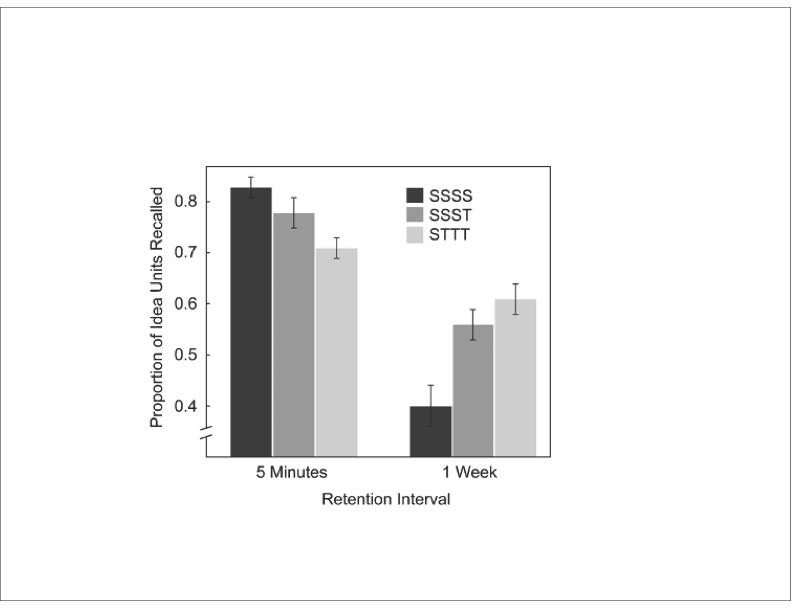
Building on the discoveries of German psychologist Hermann Ebbinghaus (1885), contemporaries Henry L. Roediger, III and Kathleen B. McDermott expand on the notion of spacing and interleaving’s efficacy in long term memory/retention [2]. In their study, participants were subjected to varying degrees of studying and testing before assessing their retention of material [2]. Studying a passage four times in one session without any testing of the material showed a higher short term retention rate than any combination of studying and testing. However, half of the participants took the assessment one week after the session where they had access to the material, and the opposite was true; participants who were tested more during the initial session showed higher long term retention than those who only studied the material several times [2]. This data is shown in the figure below from Roediger and McDermott [2]:
In another publication, albeit mainly qualitative, Benjamin L. Wiggins and his colleagues present substantial evidence that stresses the importance of repetition in higher education [3]. Their work specifically highlights the value of repetition in course-based undergraduate research experiences, but it is noted that repetition is valuable in all disciplines. The notion of repetition may seem like bitter work to the student and thus may not be popular at first, but this is nothing new. Robert Bjork’s phrase from 1994 still rings true: “desirable difficulties in learning.” Challenging students with testing has a positive impact on their education. A brain will only process information in ways that it already knows how. Furthermore, testing repetitiously leads to the establishment in new neural networks which allows information to processed in a new way. This is due to tests making students solve problems differently than they have before.
These findings demonstrate that repetition and testing in higher education are paramount to student learning. It is not a mistake to repeat the same material multiple times throughout an academic term. An instructor or professor who cares about their students’ learning should also ensure these repeated concepts make an appearance on multiple assessments.
Having very limited time to cover course materials weighs heavily on college instructors and professors, but is the goal to get through all the content or to ensure students are learning? If the latter, repeating content (with an emphasis on multimodality) may be more important than covering a lot of content in one semester.
References:
[1] Power JD, Cohen AL, Nelson SM, Wig GS, Barnes KA, Church JA, Vogel AC, Laumann TO, Miezin FM, Schlaggar BL, Petersen SE. Functional network organization of the human brain. Neuron. 2011 Nov 17;72(4):665-78. doi: 10.1016/j.neuron.2011.09.006. PMID: 22099467; PMCID: PMC3222858.
[2] Roediger HL 3rd, McDermott KB. Remembering What We Learn. Cerebrum. 2018 Jul 1;2018:cer-08-18. PMID: 30746021; PMCID: PMC6353106.
[3] Wiggins BL, Sefi-Cyr H, Lily LS, Dahlberg CL. Repetition Is Important to Students and Their Understanding during Laboratory Courses That Include Research. J Microbiol Biol Educ. 2021 Jun 30;22(2):e00158-21. doi: 10.1128/jmbe.00158-21. PMID: 34594448; PMCID: PMC8442015.
 Livingston Learning
Leave a comment